
Surgery solves a structural problem. What happens in the weeks after determines whether the solution actually translates into a better quality of life.
Post-surgical pain and stiffness aren’t just temporary inconveniences to endure — they’re clinical problems with specific causes that a skilled physiotherapist addresses directly. Left unmanaged, they become the reason a technically successful surgery produces a disappointing functional outcome.
Post surgical physiotherapy in Noida exists precisely because the gap between a good surgical result and a full functional recovery is bridged by rehabilitation, not time. This article explains what causes post-surgical pain and stiffness, how physiotherapists address each cause specifically, and what the rehabilitation process looks like for the most common procedures.
Why Post-Surgical Pain and Stiffness Happen
Understanding the mechanisms makes the treatment approach make sense. Post-surgical pain and stiffness aren’t a single problem — they’re several distinct problems that often occur simultaneously.
Surgical Inflammation
Every surgical procedure — regardless of how minimally invasive — triggers an inflammatory response. This is biologically normal and necessary for healing. But inflammation brings fluid into the tissues, increases pressure, sensitizes pain receptors, and directly limits movement.
The inflammatory response is most intense in the first three to five days and begins resolving over the following two to three weeks. Managing it actively — rather than simply waiting for it to subside — significantly reduces the discomfort and movement restriction of the early post-operative period.
Muscle Inhibition
This is one of the least understood mechanisms in post-surgical recovery and one of the most clinically significant. After surgery involving or adjacent to a joint, the nervous system effectively switches off the muscles around that joint as a protective response.
This isn’t weakness from disuse — it’s active neural inhibition. The muscles are present and structurally intact but aren’t firing properly because the nervous system has suppressed their activation in response to joint distension and surgical trauma.
Quadriceps inhibition after knee surgery is the most documented example: the degree of muscle shutdown correlates with the amount of fluid in the joint, independent of any damage to the muscle itself. Without active neuromuscular reactivation work, this inhibition can persist for months — producing the persistent weakness and altered gait that characterizes poor outcomes after knee surgery.
Scar Tissue Formation
Healing surgical incisions and disrupted internal tissue repairs through collagen deposition — scar tissue. This process is essential, but early scar tissue is disorganized and adhesive. It binds to surrounding structures — tendons, joint capsules, nerves, fascia — creating restrictions that limit movement and produce pain with normal activities.
The window for managing scar tissue is roughly the first eight to twelve weeks after surgery, while the collagen is still remodeling and relatively malleable. After that window, restrictions become significantly more permanent and harder to address.
Joint Capsule Tightening
Immobilization — even short periods — causes the joint capsule to lose elasticity and contract. The shoulder capsule is particularly vulnerable: capsular tightening after shoulder surgery can produce a frozen-shoulder-like restriction surprisingly quickly if range of motion work isn’t introduced appropriately.
Capsular restriction produces a characteristic pattern of movement limitation that responds well to manual joint mobilization in the early weeks but becomes progressively more resistant as the restriction matures.
How Physiotherapists Address Each Mechanism
Manual Therapy for Joint Stiffness and Tissue Restriction
Manual therapy is the hands-on component of physiotherapy that directly addresses the physical sources of stiffness. Several distinct techniques are used, each targeting a different aspect of post-surgical restriction.
Joint mobilization involves graded oscillatory movements applied to the joint to restore accessory motion — the small gliding, rolling, and spinning movements within a joint that must be present for full, pain-free range of motion. These movements can’t be achieved through exercise alone. When they’re restricted, every attempted movement through the joint produces mechanical irritation that perpetuates both pain and stiffness.
Soft tissue mobilization addresses the muscles, fascia, and connective tissue around the surgical site — releasing areas of tension and guarding that have developed in response to pain and immobilization.
Scar mobilization begins once the surgical wound has adequately healed — typically two to four weeks post-operatively, depending on the procedure and individual healing. The physiotherapist works directly on and around the scar tissue, mobilizing it to prevent adhesion formation and encourage functional collagen alignment. Done consistently through the remodeling window, this intervention produces meaningful long-term differences in tissue extensibility. Left untreated, the same scar tissue frequently produces restrictions felt for years after the original surgery.
Neuromuscular Reactivation for Inhibited Muscles
Getting inhibited muscles to fire again requires deliberate neuromuscular work — not just general exercise. The specific techniques depend on the location and degree of inhibition.
Isometric contractions — muscle contractions without joint movement — are often the starting point when joint loading needs to be minimized. A simple isometric quad set after knee surgery (tightening the thigh muscle while the leg rests flat) looks unremarkable but does important work: re-establishing the neural pathway between the motor cortex and the inhibited muscle.
Neuromuscular electrical stimulation (NMES) uses electrical current to produce muscle contractions in muscles that can’t generate adequate voluntary contraction. It’s particularly effective for quadriceps reactivation after knee procedures, where the degree of inhibition often prevents effective voluntary exercise in the early post-operative period. The electrically induced contraction reduces the inhibition while building early muscle activation.
Biofeedback — using surface electromyography sensors to provide real-time feedback on muscle activation — helps patients achieve muscle contractions they can’t otherwise reliably generate. Seeing the feedback that the muscle is activating enables the nervous system to learn the pattern more quickly than exercise alone.
Procedure-Specific Rehabilitation Approaches
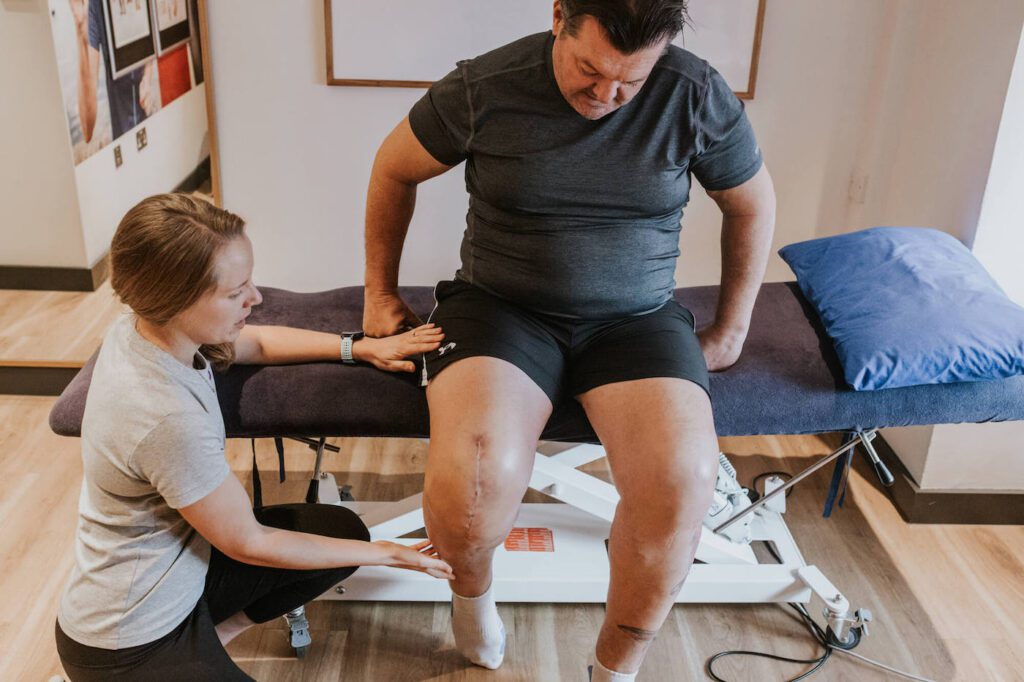
Total Knee Replacement
Stiffness is the defining challenge after total knee replacement. The target for flexion range in the first two weeks is typically 0–90 degrees, with 120 degrees by six to eight weeks. Falling below these benchmarks has direct functional consequences — stair climbing requires approximately 100 degrees of flexion, and adequate sitting comfort requires more.
Manual patellofemoral joint mobilization is essential in the early weeks after knee replacement. The surgical approach disturbs patellar mobility, and if patellar tracking isn’t addressed early, it becomes a persistent source of anterior knee pain and flexion restriction.
Scar mobilization along the anterior knee is equally important — the surgical incision here can restrict patellar mobility through adhesion formation if not addressed while the tissue is still manageable.
Quadriceps reactivation begins from day one. The inhibition after knee replacement is significant and immediate. Patients who leave the hospital without adequate quad activation have a much harder rehabilitation trajectory than those who achieve basic quad control before discharge.
Shoulder Surgery — Rotator Cuff Repair
The rotator cuff is one of the most demanding post-surgical rehabilitation scenarios because the repair requires significant early protection — four to six weeks of sling immobilization with only pendulum exercises and passive range of motion permitted — followed by a carefully graduated return to loading.
This enforced early immobilization makes capsular stiffness and periscapular muscle weakness almost inevitable. The physiotherapy in weeks six to twelve is focused precisely on reversing these effects — restoring glenohumeral range of motion through manual mobilization, reactivating the rotator cuff and scapular stabilizers through progressive strengthening, and rebuilding the dynamic shoulder stability that functional overhead activity requires.
The transition from passive to active-assisted to active movement must respect the tissue healing timeline. Loading the repair before the tendon has adequate strength risks failure — which returns the patient to the beginning of the process with a more complex surgical situation. A skilled physiotherapist at a quality physiotherapy clinic in Noida knows this progression and manages it precisely.
Spinal Surgery — Lumbar Procedures
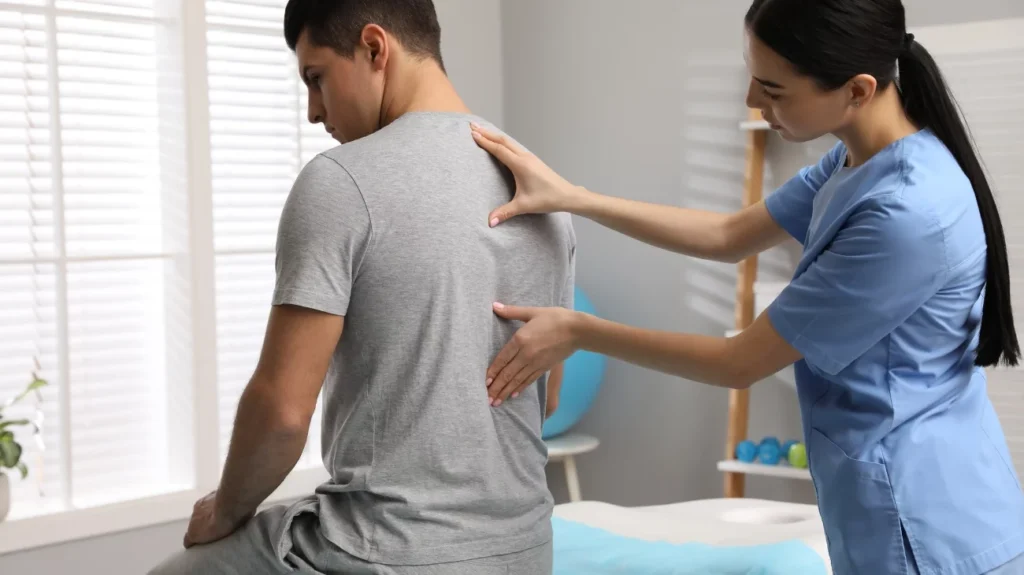
Post-surgical physiotherapy after lumbar discectomy, fusion, or laminectomy addresses a different set of problems than limb surgery. The primary concerns are protective paraspinal muscle spasm, loss of spinal segmental control, and fear of movement that can severely limit functional recovery.
Paraspinal muscle spasm after spinal surgery is intense and clinically significant. The muscles go into protective guarding that is genuinely painful and limits movement beyond what the surgical healing itself requires. Soft tissue release of the paraspinal muscles, combined with gentle progressive mobilization, reduces this guarding significantly faster than time alone.
Deep stabilization work — reactivating the transversus abdominis and multifidus muscles that provide segmental spinal control — is the foundation of functional spinal recovery. These muscles are consistently inhibited after spinal surgery and deconditioning, and their recovery doesn’t happen automatically. Specific exercises targeting deep stabilization, progressed carefully through the healing phases, create the muscular foundation for a spine that moves freely and with confidence.
Best Physiotherapy Clinic Noida — What Good Post-Surgical Care Looks Like in Practice
Surgeon-Physiotherapist Communication
The rehabilitation program needs to align precisely with what the surgeon has specified. Post-operative precautions — weight-bearing restrictions, movement limits, sling protocols — exist for specific reasons related to the structural integrity of the repair. Working outside those parameters risks undoing the surgical work.
The best physiotherapy clinic Noida has for post-surgical care maintains active communication with surgical teams — understanding the specific procedure, the surgeon’s specific precautions, and the intended progression timeline. This communication loop makes the difference between rehabilitation that is both safe and optimally progressive, and rehabilitation that either risks the repair or is unnecessarily conservative.
MotionRX coordinates directly with referring surgeons for post-surgical cases, ensuring every rehabilitation program is built on accurate clinical information rather than generic post-operative protocols.
Objective Progress Tracking
Good post-surgical physiotherapy measures progress objectively at regular intervals — not just “how are you feeling today.” Range of motion measurements, strength testing against normative values or limb symmetry ratios, functional movement assessments — these objective markers tell you honestly whether you’re on track and flag issues early enough to address them.
Patients who receive regular objective progress reviews have better outcomes than those managed primarily on subjective report. Knowing you’re at 85% quadriceps symmetry at week twelve gives you a specific target to work toward. Knowing you’re at 115 degrees of knee flexion tells you whether the manual therapy and exercise work is producing the structural change it should.
The Home Program — Where Recovery Mainly Happens
Physiotherapy sessions are typically two to three times per week. What happens on the other four or five days determines the rate of progress far more than what happens in the clinic.
A well-structured home exercise program — specific exercises at prescribed dosages, with clear guidance on pain monitoring and progression — is not an optional add-on to post-surgical physiotherapy. It’s where the rehabilitation actually occurs between sessions. The clinical sessions provide the hands-on intervention, the assessment, and the exercise prescription. The home program is where that prescription is executed.
What Patients Can Do to Support Post-Surgical Recovery
Take swelling management seriously. Ice fifteen to twenty minutes after exercise or activity in the early weeks, elevation during rest, compression where indicated — these aren’t passive comforts. They actively reduce the swelling that inhibits muscle function and limits range of motion.
Do the home exercises every single day. Not when convenient. Every day. The compounding effect of daily neuromuscular work and progressive tissue loading is the mechanism through which recovery accelerates. Inconsistency extends the timeline significantly.
Report changes in symptoms. Pain that worsens significantly, new swelling or warmth at the surgical site, fever, or pain that develops a different character — these warrant prompt communication with both your physiotherapist and your surgeon. Don’t wait for the next scheduled appointment if something has noticeably changed.
Understand that some discomfort during rehabilitation is expected. Gentle, manageable discomfort during therapeutic exercise is not a sign that something is wrong — it’s often a sign that appropriate demand is being placed on healing tissue. The guidelines are: pain during exercise should stay below a 4/10, and should return to pre-exercise baseline within twenty-four hours. Within those parameters, progression is appropriate.
Be patient with the timeline but not passive within it. Recovery takes the time it takes — but your effort and consistency within that timeline determine the quality of the outcome. Showing up, doing the work, and following the program produces dramatically better results than passive waiting.
Conclusion
Post-surgical pain and stiffness are predictable consequences of the surgical process — but they’re not inevitable long-term outcomes. With appropriately timed, clinically precise physiotherapy, both can be addressed directly and effectively, producing the full functional recovery that surgery was intended to enable.
Post surgical physiotherapy in Noida from a skilled and experienced physiotherapist like those at MotionRX gives patients the active, evidence-based rehabilitation that bridges the gap between a good surgical outcome and a full return to the life they want to live.
Take the rehabilitation as seriously as the surgery. That’s where your actual recovery happens.